Frozen Burst Pipe Repair in Spartanburg, SC

Frozen burst pipe repair in Spartanburg, SC

Spartanburg is not a cold city, and that is precisely why frozen pipes do so much damage here. Hard freezes arrive a handful of nights each winter rather than lasting for months, so a great deal of local plumbing was never built to survive one. Supply lines run through open crawlspaces, up exterior walls, through unheated garages and out to hose bibs with little or no insulation. The same pipe in a colder state would be buried, lagged and heated. Here it sits exposed, waiting for one night in the twenties.

This page covers frozen burst pipe repair, Spartanburg SC: the split you have already found, and the one you suspect because a tap has stopped running and you are waiting to see what happens when it thaws.

Why frozen pipes burst, and where the split actually happens

Water expands as it turns to ice. Inside a closed pipe that expansion has nowhere to go, so pressure builds between the ice plug and the nearest closed tap. The pipe then fails at its weakest point, which is frequently not where the ice is. A split can appear several feet along from the frozen section, which is why hunting for frost on a pipe is a poor way to find the damage.

The damage also shows up late, and this catches almost everyone out. While the plug is frozen it is sealing the split, so nothing leaks. The water arrives when it melts, usually the next afternoon when the sun comes round or when somebody turns the heating up. The mess appears after the cold has passed, and people naturally assume the danger passed with it.

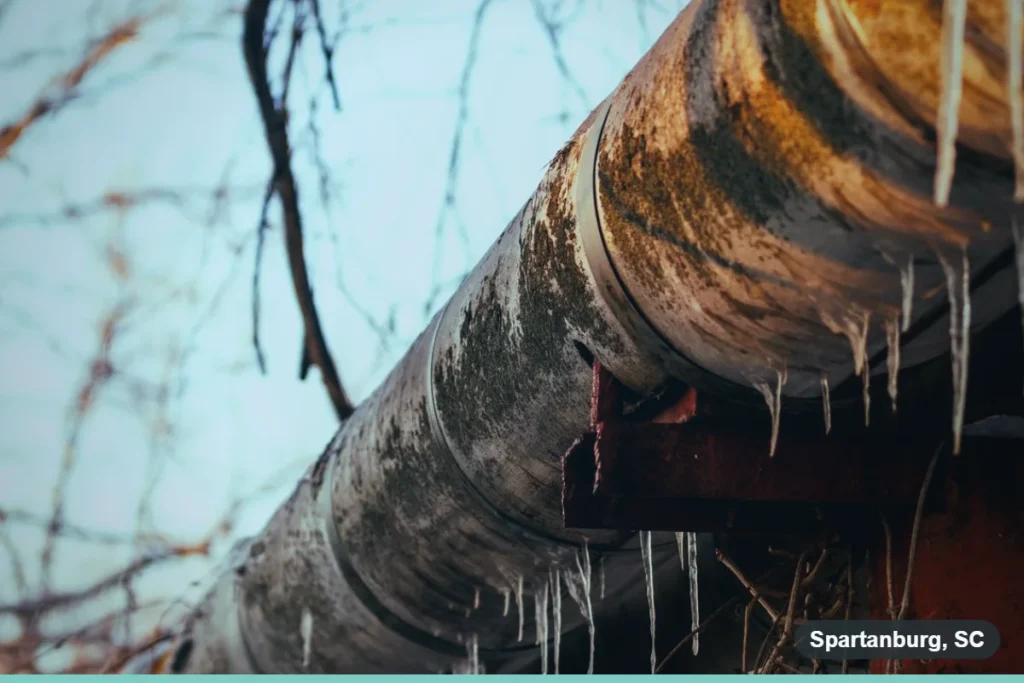
Icy water pipe with icicles dripping in winter, why frozen pipes burst in Spartanburg SC

Where it happens in Spartanburg houses

  • Crawlspaces. The most common location locally by a wide margin. Open vents, no heat, and supply lines running the length of the house just above the ground.
  • Exterior walls. Particularly a north facing wall, and particularly where a pipe runs up to a kitchen sink on an outside wall.
  • Hose bibs and outdoor taps. The split is often inside the wall behind the bib rather than at the visible fitting, so the water turns up indoors.
  • Unheated garages and utility rooms. Water heaters and washer connections in a garage are a recurring one.
  • Attic runs. Less common here than further north, but present in some additions and converted spaces.
Frost covered pipes and red valves, frozen pipe thaw and repair in Spartanburg SC

What this service covers

Locating the frozen section and the split, which are not always in the same place. Thawing the line under control where it is still frozen. Cutting out the failed length well beyond the damage on both sides, because pipe stretched by ice is rarely sound right up to the tear. Fitting new pipe and making the joints. Bringing pressure back gradually while the whole accessible run is watched, since a line that froze in one spot has very often been weakened in several.

The inspection also covers what allowed the freeze in the first place: an uninsulated run, an open crawlspace vent, a gap where a pipe passes through an exterior wall, a hose left connected to an outdoor tap through autumn. Repairing the split without noting any of that simply books next winter’s call.

For homes

Older homes closer to the centre of town are the classic case. Crawlspace construction, sometimes original galvanized steel on the first runs, and decades of internal corrosion already thinning the pipe walls before any ice arrives. A freeze finishes off a line that was most of the way there, and the water drops into the crawlspace where it can run a long time unnoticed.

Newer slab built homes freeze in different places. With no crawlspace, the vulnerable runs are in exterior walls, the garage and the attic. A split inside a wall cavity shows as a damp patch of drywall or a baseboard going dark, and finding it takes equipment rather than a torch and a look.

Frozen outdoor water tap dripping in winter, frozen pipe repair for Spartanburg SC homes
Icicles on an outdoor pipeline in winter, frozen pipe repair for Spartanburg SC businesses

For businesses

Commercial freezes cluster in the places nobody heats: stockrooms, roof spaces, utility cupboards, and exposed risers in older converted buildings. A long holiday weekend with the heating set back is the standard trigger. The building is empty, nobody notices the tap that stopped running, and the discovery happens on Monday morning in several inches of water.

If a building will sit empty through a cold spell, closing the main and draining the system down matters more than any amount of insulation. Say on the call whether the building was occupied when it happened, because it changes where to start looking.

What the work actually involves

The water goes off first, even when nothing is leaking yet, because thawing a split line turns a frozen pipe into a running one. The frozen section is then warmed gradually, never with an open flame. Flame splits more pipe than it saves and it has started house fires. As the ice releases, the line is watched closely, because that is the moment a split reveals itself.

Once the damage is visible the failed length comes out, with cuts into sound pipe on both sides. New material goes in, joints are made and allowed to set where the material requires it, and pressure returns slowly. On an older house the rest of the accessible run then gets looked over for the stretched, bulged or dull sections that say a freeze passed through there too.

How this service works

  1. Call and describe it. Which tap stopped, when the freeze was, whether water has appeared yet.
  2. Water off. Before thawing, not after.
  3. Thaw and find the split. Gradual warming, close watch as the ice releases.
  4. Fix and check the flow. Failed section replaced, pressure back slowly, full run inspected.

Tools and methods

Controlled heat for thawing rather than open flame. Pipe cutters and deburring tools. Repair couplings, slip couplings and transition fittings for joining new pipe to galvanized, copper, CPVC or PEX. Acoustic listening equipment for runs inside walls. A moisture meter to trace how far water has travelled behind a surface. Pressure gauges, because a supply already running high is what turns a weakened pipe into a burst one.

When to call

  • A tap has stopped running after a cold night. There is ice in that line. The question now is how it gets thawed, because doing it wrong is how a frozen pipe becomes a flooded room.
  • The freeze has passed and now there is water. The split was sealed by its own ice and has just opened. This is the most common version of this call.
  • An outdoor tap worked before the freeze and now does nothing. Often a split inside the wall behind the bib, which will show indoors.
  • You have come back to an empty property after a cold spell. Go to the main shutoff before you go looking for the damage.

Problems this service fixes

  • Freeze splits in crawlspace runs. The commonest frozen burst locally, and often the slowest to be noticed.
  • Splits behind hose bibs. The visible fitting looks fine; the failure is in the wall.
  • Freeze damage on top of old corrosion. Galvanized line already thin, and ice finishes it.
  • Lines still frozen and not yet split. Thawed under control before they become the other kind of call.
  • Repeat freezes in the same run. Same pipe, same spot, every hard winter. The cause gets identified, not just the split.

What you receive

The frozen section thawed without making things worse. The split length replaced with new pipe and proper fittings. The accessible run checked for further freeze damage. The line tested under pressure before anyone leaves. A plain account of why that particular pipe was the one that froze. The work area left clean.

What to know before you call

Never use an open flame on a frozen pipe. No blowtorch, no propane. It cracks pipe and it has set fire to houses. Gentle, even warmth is what works.

Let your faucets drip in a freeze. This is Spartanburg Water’s own advice ahead of winter weather, and it works, because moving water is much harder to freeze than still water. The utility’s spokesperson has said plainly that they do expect to see some pipes burst and some water line breaks during a freeze event. The tap to open is the one furthest from where the supply enters the house.

Find your main shutoff before winter. Usually a meter box near the street, a valve where the supply enters the house, or inside the crawlspace. Locating it on a mild day beats hunting for it with a torch at midnight.

Open the cupboards under sinks on exterior walls. It lets house warmth reach the pipes. A small thing that repeatedly works.

Disconnect garden hoses in autumn. A connected hose holds water against the bib and gives the freeze somewhere to start.

If water is coming up in the street or at the meter, it is not your pipe. Spartanburg Water handles breaks on their side on 864-582-6375.

Common questions

Not yet. While the ice plug is in place it seals any split behind it, so the leak shows during the thaw. The safe move is to shut the water off at the main and have the line thawed under control rather than waiting to find out.

On a short, accessible run, gentle warmth worked slowly along the pipe can release a plug. Two conditions: close the main first, and stop at once if water appears. Never an open flame, and never a space heater left unattended in a crawlspace.

It depends on the damage. A pipe that froze without splitting may only need thawing and checking. One that split needs the burst section cut out and replaced, with the cuts made into sound pipe either side, because ice-stretched pipe is weak beyond the visible tear.

Because the ice was holding the split closed. When it melts, the pipe is already broken and the water finally has a path out. This is normal and it is the single most misunderstood thing about frozen pipes.

Yes, and the Upstate sees far more of it than the coast. The National Weather Service office in Greenville-Spartanburg issues the freeze warnings that cover upstate South Carolina, and Spartanburg Water publicly expects burst pipes and line breaks when those nights arrive.

PEX has some give and tolerates a freeze better than rigid pipe, though it is not freeze proof. Copper splits. Galvanized steel, already thinned by corrosion in older houses here, is the most likely to fail. Material gets discussed when a run is being replaced rather than patched. See burst pipe replacement.

Insulate the exposed run, close or seal crawlspace vents during a freeze, fill the gap where the pipe passes through an exterior wall, disconnect hoses from outdoor bibs in autumn, and drip a tap when a hard freeze is forecast. Which of these applies to your house gets noted during the repair.

Call now

Frozen or split line? Close the main valve, then call for frozen burst pipe repair, Spartanburg SC.