
Burst Pipe Replacement in Spartanburg, SC

There is a point where mending a pipe stops being the sensible answer. A line that has burst twice in two winters, a galvanized run that is thin along its whole length rather than at one spot, a section that was patched in a hurry during an emergency and was always meant to be dealt with properly later. Burst pipe replacement, Spartanburg SC, is that second visit: taking out the pipe that keeps failing rather than mending it once more.
Patch or replace
Both are legitimate, and the honest answer depends on what the pipe is and why it failed.
A patch is right when a sound pipe failed at one identifiable point for an identifiable reason. A copper line that froze in an uninsulated crawlspace, a fitting that was poorly made, a nail through a pipe during a renovation. Cut out the damage, put in new, fix the cause, and that line will outlive the house.
Replacement is right when the pipe itself is the problem. Galvanized steel corrodes from the inside along its entire length, so the spot that burst is simply the thinnest point of a pipe that is thin everywhere. Patch it and the next failure is somewhere else in the same run, usually within a year or two. The same logic applies to polybutylene, which was installed widely in American homes between the late 1970s and the mid 1990s and has a known record of brittle failure at the fittings.
You get told which of these you are looking at, with the reasoning, and the choice stays yours. Nobody should be sold a repipe for a pipe that only needed a coupling.
Pipe materials, and what each one means for you
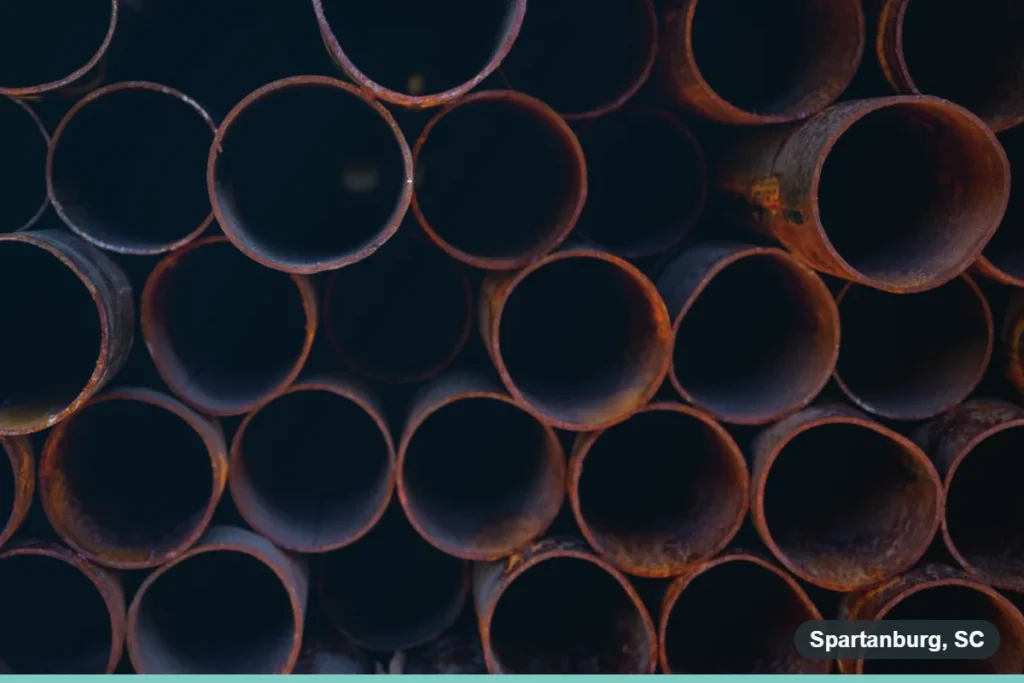
Galvanized steel. Found in older Spartanburg houses. Zinc coated steel that rusts internally, narrowing the bore and thinning the wall. Early signs are discoloured water, falling pressure, and repeated pinhole leaks. It does not get better, and a section that bursts is telling you about the whole run.
Polybutylene. Grey or sometimes blue flexible plastic, common in houses of the late 1970s to mid 1990s. Failures tend to start at the fittings. If a house has it and a burst has happened, replacement of the system rather than the section is the usual conclusion.
Copper. Long lived and generally reliable. It splits when frozen and it develops pinholes where water chemistry or high velocity has worked on it for decades. A copper line that failed from a freeze is usually a patch, not a repipe.
CPVC. Rigid plastic, fine in service, but it becomes brittle with age and can crack rather than split, particularly where it has been stressed at a joint or exposed to sunlight before installation.
PEX. Flexible plastic, now the common choice for replacement work. It has some give, which means it tolerates a freeze better than rigid pipe, though it is not freeze proof. It needs fewer joints, which matters because joints are where things leak, and it can often be routed through walls without opening as much of them.
What replacement actually involves
The water goes off, the extent of the run being replaced is agreed with you before anything is cut, and access is opened at the smallest number of points that will do the job. On a crawlspace house that usually means working from underneath, which is far less disruptive than it sounds. On a slab house it means a decision: break into the concrete to reach the buried line, or abandon that section and reroute the new pipe overhead through the wall or ceiling. Rerouting is frequently the less destructive route overall and it is always put on the table.
New pipe is run, supported properly at the right intervals, and insulated where it passes through unheated space, because an uninsulated crawlspace run is how the first pipe got into trouble. Transitions to the existing plumbing are made with proper fittings, including the dielectric fittings needed where copper meets galvanized, since joining those two metals directly accelerates corrosion at the joint.
Then the system is pressurised, held, and watched. Every new joint is checked under load, taps are run to clear air and debris, and the water comes back gradually rather than all at once. The work area is cleaned up, and any drywall or flooring that had to be opened is left in a state ready for the trade that closes it, with a clear account of what was opened and why.
For homes
In older crawlspace homes nearer the centre of town, replacement is usually a run at a time rather than a whole house, because the galvanized sections and the previously replaced copper sections sit side by side. Working out which is which, and replacing the parts that are actually failing, keeps the job proportionate.
In slab built homes the question is almost always routing rather than material. Getting a new line to where it needs to go without breaking a floor is the thing worth planning carefully, and it is usually possible.
For businesses
Commercial replacement is a scheduling problem. The work itself is ordinary; the constraint is when the water can be off and for how long. Where a building has zone valves, sections can be replaced with most of the building still in service. Where it does not, the sequence has to be planned around the hours you can afford to be without water.
Tell us what the building does, what it cannot do without, and what hours are workable. The plan gets built around that rather than presented as a fixed arrangement.

Tools and methods
Pipe cutters and deburring tools. Press fittings, compression fittings, soldered joints and transition couplings as the material requires. Dielectric fittings at copper to galvanized transitions. Pipe supports and insulation for runs through unheated space. Pressure gauges for testing the finished work and for checking whether supply pressure needs regulating, because replacing a pipe without addressing pressure that is too high just resets the clock.
When to call
- The same line has burst more than once. The pipe is the problem, not the spot.
- Your water runs discoloured, or pressure has been falling for years. Both point at galvanized corrosion narrowing the bore.
- You have grey polybutylene and it has started leaking. Failures tend to continue at the fittings.
- An emergency patch is holding and you want it done properly. Patch first, replace second is the correct order, and the second part should not be forgotten.
Problems this service fixes
- Galvanized runs failing repeatedly. Replaced rather than patched toward the next leak.
- Polybutylene fitting failures. Addressed as a system rather than a section.
- Buried slab lines. Rerouted where that is less destructive than breaking concrete.
- Freeze damaged sections. Replaced beyond the visible split, into sound pipe, and insulated afterwards.
- Temporary emergency patches. Made permanent properly.
What you receive
The failing pipe replaced over the agreed length, new pipe supported and insulated correctly, proper transitions to the existing system, the whole thing pressure tested and watched under load before anyone leaves, a clear account of what was replaced and what was deliberately left, and the work area cleaned up.
What to know before you call
Find out what your pipe is, if you can. A look in the crawlspace or under a sink tells you a lot. Grey plastic, dull galvanized grey metal, or copper all point in different directions, and knowing it before the call makes the conversation more useful.
Supply pressure matters. Pressure that sits too high shortens the life of every pipe and fitting in the house. If pressure has never been checked, that is worth doing as part of the work.
Replacement is planned work, not emergency work. If water is running right now, that is a different call. Deal with the water first through emergency repair, then plan the replacement without a clock running.
Insulate what gets replaced. A new pipe in the same uninsulated crawlspace will freeze in the same place. This is part of the work rather than an extra.
Common questions
It depends on the material and its condition along the whole run. A sound copper line that froze needs a section. A galvanized run that is thin everywhere, or polybutylene failing at its fittings, points toward replacing the system. You get the reasoning and the choice.
As little as will do the job, and the access points are agreed before anything is cut. In a crawlspace house, often none at all, because the work happens from underneath. In a slab house, rerouting through a wall or ceiling frequently avoids breaking concrete entirely.
Usually PEX for replacement work, because it needs fewer joints, tolerates a freeze better than rigid pipe, and can often be routed without opening as much structure. Copper is used where it is the better fit for the situation. It gets discussed rather than decided for you.
For the working period on the section being replaced, and only for that branch where the plumbing can be isolated. The scope and the likely duration are agreed before the work starts, so it is planned rather than discovered.
Yes, if the pipe is sound and the failure was local. If the same run keeps going, a patch is buying a few months and you should know that before choosing it.
Grey flexible plastic is likely polybutylene, widely installed between the late 1970s and the mid 1990s, with a known pattern of failure at the fittings. If it has already leaked once, replacement of the system is the usual recommendation rather than repeated repairs.
Only if the reason it froze is dealt with at the same time. New pipe in the same uninsulated crawlspace with the same open vent will freeze in the same place. Insulation and routing are part of the job, not an afterthought.
Areas we serve for this service
Call now
Tired of mending the same line? Call about burst pipe replacement, Spartanburg SC.